Disabilities in Latin America
In the countries where NPH works, over 16 million people live with disabilities.
Inclusive care for vulnerable people with disabilities is a key component of NPH’s work.
Some aspects of disability are particularly marked in Latin America:
- Violence contributes significantly to disability – 17 of the world’s 20 most violent countries are in the region.
- Lack of refugee enrolment in healthcare systems, the tendency to leave disabled family members behind when migrating, and the psychosocial stresses on migrants make migration a potent contributor to disability. Some children and adults with disabilities are in residential care with NPH because their family members migrated and abandoned them. Others live an unstable existence, having been left with extended family members.
Longer term, Latin America is one of fastest-ageing regions in the world – the share of older people is expected to double between 2019 and 2050. With age comes higher prevalence of disabilities.
As a practical example of the challenges faced by those with disabilities, any visitor to the countries where NPH works will have seen the obstacles to mobility presented by a significant proportion of the built environment in Latin America.
Challenges for people with disabilities
People with disabilities typically face the following challenges:
Over-represented
among those vulnerable to
poverty
More likely to live in poor households
Less educated and less likely to form part of the labour force
Disability’s hidden opportunity
However, inclusiveness of people with disabilities does more than just enhance their own lives, but conceals an opportunity: The World Bank estimates that globally there is a 3-7% drop in GDP through exclusion of people with disabilities.
Disability rights in Latin America
The Inter-American Convention on the Elimination of all Forms of Discrimination against Persons with Disabilities (1999) was the first major legal change in the region.
It called on states to adopt measures to “eliminate discrimination against persons with disabilities and to promote their full integration into society”, but to date has only been ratified by 19 of 34 states.
NPH’s approach to disability care
Because NPH’s work is focussed on vulnerable children, we inevitably support a high proportion of households that include someone with a disability.
“We at NPH stand up for a genuinely inclusive society, where no one is left behind because of disability, ethnicity, religion or gender identity. Inclusivity not only changes the life of people with disabilities; it opens doors to a more ethical, empathetic and respectful world.”
– Nelly Fernández, Head of Family Wellbeing, NPH International
The majority of people with disabilities – physical, cognitive and communicative – in residential care with NPH are adults. The most frequently diagnosed disabilities are cerebral palsy, intellectual disabilities, autism and Down’s Syndrome.
Those receiving care for disabilities in our community programmes are mainly children and adolescents.
Holistic care for people with disabilities

NPH provides the following services for people with disabilities:
Healthcare
- Nutrition adjusted to the individual needs of each person
- Psychological support
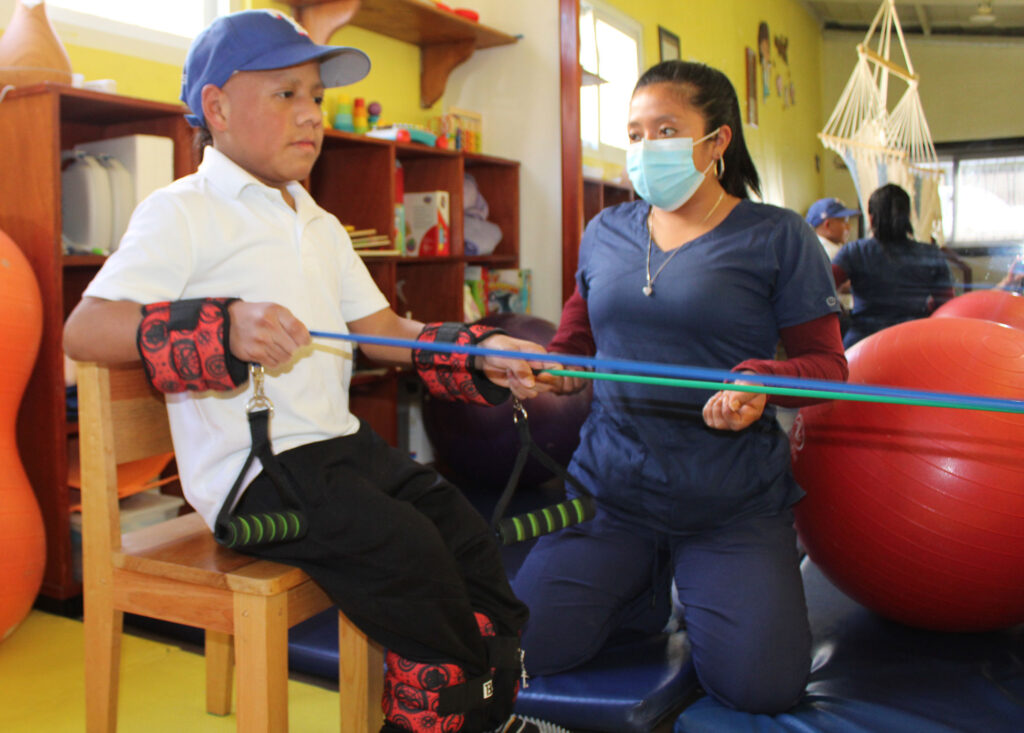
- Rehabilitation: physical therapy, speech therapy and occupational therapy
Inclusive, high-quality education
- Inclusive schools offering support tailored to educational needs
- Tutoring and additional teaching support
Childcare centres
All NPH childcare centres provide inclusive care for children, adolescents and young people, whether they have disabilities or not, including those in residential care1.
At this stage in life, inclusiveness promotes the cognitive, emotional and social development of those with disabilities.
Specialised residential care centres
NPH provides specialised residential care for adults with disabilities, as they have different needs than children and young people. These are separate facilities for adults in the same locations as our childcare centres at NPH in Guatemala, Honduras and Dominican Republic.
In Haiti, the NPH Special Needs Programme has been providing residential care, education and therapy to children and adults with physiological and neurological conditions since 1993.
Youth empowerment and social and labour market inclusion
These are the programmes where NPH has the toughest challenge to promote participation of people with disabilities, but we are strongly committed to progress.
If they have mild learning difficulties and are capable of living independently, our aim is that they find work outside NPH so that they can integrate into society and the workforce, or continue with their studies if they are able to.
Relationship to SDGs
NPH considers the following SDGs to be most closely related:
Objective 3 – Good Health and Wellbeing
Access to healthcare (primary care, specialist care and rehabilitation, etc.) is a challenge for people with disabilities in Latin America and the Caribbean, especially in rural areas.
NPH provides primary healthcare services for people in residential care with us. We also use external services to care for children, adolescents, and young adults who need specialist treatment.
In addition, NPH provides rehabilitation services in the areas of physical therapy, speech therapy, and occupational therapy, both in residential and community programmes.
Objective 4 – Quality Education
Quality, inclusive education is almost non-existent in the areas where NPH operates. State schools barely understand the needs of children with disabilities and frequently take the wrong approach, which results in children being stigmatised. Schools lack the understanding of how to offer people with disabilities a quality education.
NPH schools are developing their methodology to align themselves with the UNICEF-recommended Universal Design for Learning (UDL). We are also committed to setting up psycho-pedagogical teams and departments to support those with special educational needs, including disabilities.
The NPH centres in Guatemala, Honduras and Nicaragua are all doing exemplary work in integrating people with disabilities into mainstream education at public schools.
Additionally, NPH is working to promote inclusion and quality education for people with disabilities and special educational needs in our engagement with schools in neighbouring communities.
Objective 8 – Decent Work and Economic Growth
One of the biggest challenges for society at large and for NPH is to ensure the social and work market inclusion of people with disabilities. This is the area to which fewest resources are dedicated and where inclusivity is hardest to ensure.
Objective 10 – Reduced Inequalities
NPH programmes provide inclusive and specific care, guaranteeing quality services to poeple with disabilities. In addition, NPH has a zero-tolerance policy toward any type of discrimination.
How you can help personally
Help us continue to provide a better life for vulnerable people with disabilities in the 9 countries in Latin America and the Caribbean where we work.
A partner for trusts and foundations
Do you work with a charitable trust or foundation interested in investing in care for people with disabilities in Latin America? We are a trusted partner for such organisations and would love to hear from you. Read more about our partnerships or contact us.
Sources
UNICEF resources on disability rights
UN Convention on the Rights of Persons with Disabilities
- NPH Nicaragua does not provide residential care. ↩︎


